

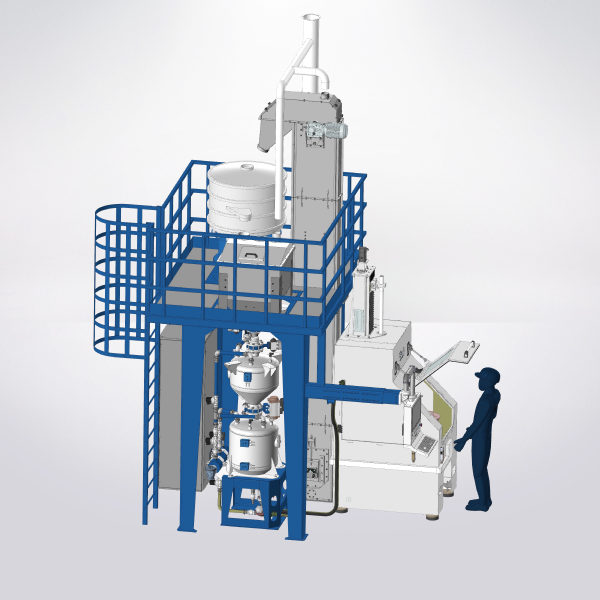
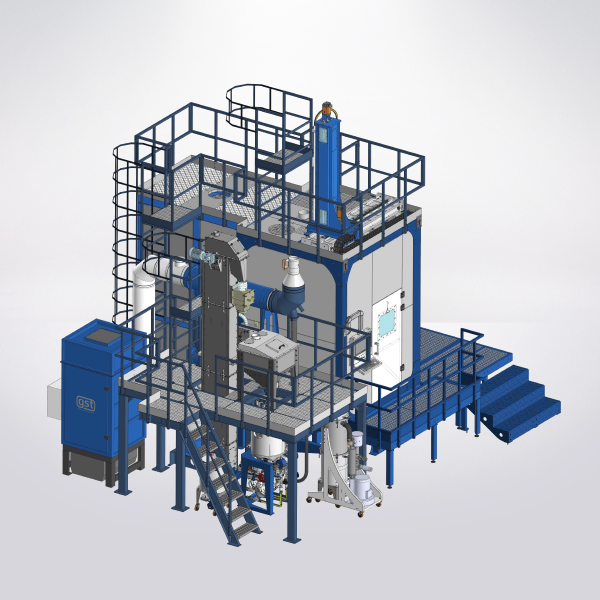
Abrasive blasting equipment is used to prepare component surfaces before thermal spraying by removing scale, oxides, corrosion products and other contaminants and by creating the surface profile required for coating adhesion. Controlled surface preparation helps provide a clean, uniformly roughened substrate for repeatable coating deposition.
GST supplies industrial blasting equipment for manual, mechanized and automated surface preparation. System configuration is selected according to component size and geometry, substrate material, abrasive media, production rate and the required level of process control. Blasting systems can be integrated with handling equipment, dust extraction and complete thermal spray systems.
How abrasive blasting works
In abrasive blasting, compressed air accelerates abrasive media through a blasting nozzle toward the component surface. The impact removes surface contaminants and alters the surface texture. Process stability depends on controlled air supply, abrasive flow, nozzle condition, working distance and the selected blasting media.
For thermal spray applications, grit blasting is normally performed after degreasing and other required cleaning operations and as close as practical to the coating step. Limiting the delay between blasting and spraying helps reduce the risk of oxidation, moisture pickup or recontamination of the prepared surface.
Blast cabinets and blast rooms
A blast cabinet provides an enclosed working area for small and medium-sized components, while a blast room is intended for larger parts, assemblies and workpieces that require operator access or mechanized handling. Depending on the application, sandblasting equipment can be arranged for manual operation or integrated with manipulators, turntables, positioners or robotic motion.
Industrial blasting equipment can also include abrasive recovery and recirculation, air preparation, media separation and a dust collector. These peripheral units help maintain visibility, contain airborne particles and support stable operation of the blasting process.
What a complete system includes
A complete abrasive blasting equipment package can include the blast cabinet or blast room, pressure blasting unit, nozzle and hose assembly, compressed-air preparation, abrasive storage and recovery system, media separator, filtration and ventilation, control cabinet and safety interlocks. The exact configuration is selected for the required production process and component handling method.
Automated systems can coordinate component motion, blasting nozzle movement, abrasive delivery and extraction as one controlled process. Integration with upstream cleaning and downstream coating operations can reduce manual handling and support consistent surface preparation in serial production.
Abrasive media and applications
Common abrasive media include aluminum oxide (corundum), silicon carbide and metallic grit or shot. Media type, particle size and condition are selected according to the substrate, required cleanliness and surface profile, and the coating specification. For thermal spray preparation, the abrasive must create the required profile without introducing unacceptable contamination or damaging the component.
Blasting systems are used for surface cleaning, oxide and scale removal, coating removal and preparation of metallic substrates before plasma spray, HVOF, flame spray and other thermal spray processes. The required equipment and abrasive are selected according to the component material, geometry and subsequent coating operation.
Blasting and shot peening
Abrasive blasting and shot peening are different surface-treatment processes. Blasting is primarily used for cleaning and surface preparation, including creation of a roughness profile before coating. Shot peening uses controlled repeated impact to modify near-surface mechanical properties and introduce compressive residual stresses. For strengthening applications, see our shot peening systems.
Delivery, commissioning and support
GST provides blasting system configuration, integration, commissioning and operator training. Service and support can include installation assistance, process start-up, selection of peripheral equipment and integration of a dust collector with new or existing surface-preparation and thermal spray production lines.