

Atmospheric Plasma Spray (APS)
Atmospheric plasma spray (APS) is a thermal spray process used to apply functional and protective coatings to prepared component surfaces in ambient atmosphere. An electric arc converts a plasma-forming gas into a high-temperature plasma jet that heats and accelerates powder particles toward the substrate, where they build a controlled coating layer.
The process is used when a coating material must provide thermal protection, wear resistance, corrosion resistance, electrical insulation or another engineered surface property. Atmospheric plasma spraying is especially important for ceramic and oxide coatings, while metal alloys and composite powders can also be processed for demanding industrial applications.
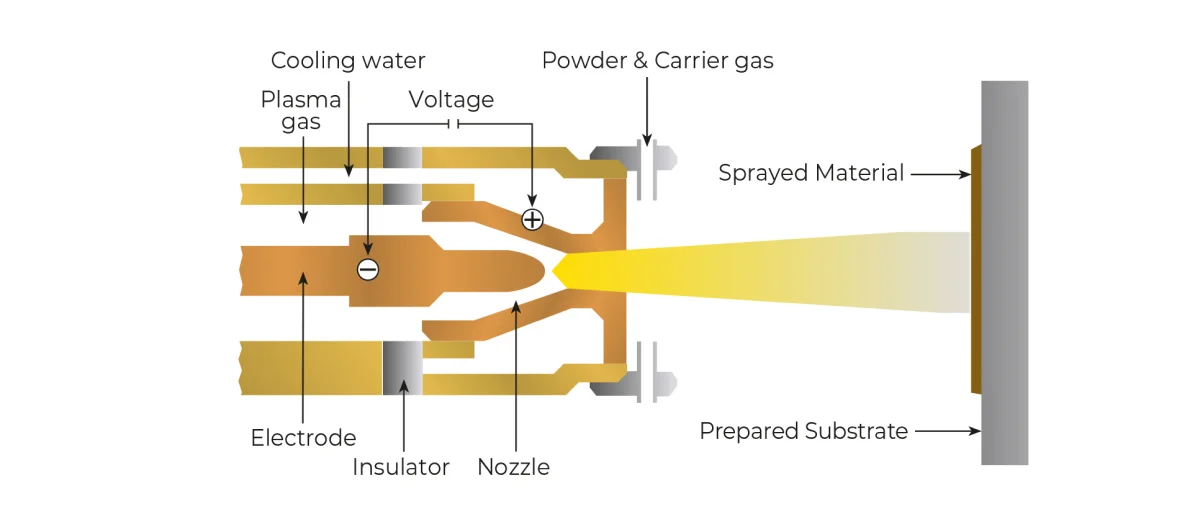
How the plasma jet is formed
Inside the plasma spray gun, an electric arc is established between the cathode and anode. A plasma-forming gas passes through the arc zone, absorbs electrical energy and becomes a rapidly expanding plasma. Argon is commonly used as a primary gas, while mixtures containing hydrogen or helium can modify heat transfer, gas enthalpy and plasma-jet behavior for a coating material.
The resulting plasma jet combines high temperature with high energy flow. Its stability depends on electrical parameters, gas composition, gas flow and plasma spray gun geometry. Because the process operates in air, the jet interacts with the surrounding atmosphere before it reaches the component surface and prepared substrate.
Powder injection and particle heating
Powder is metered into the plasma jet by a powder feeder and transported through an injector by carrier gas. The injection point and direction are selected so powder particles enter the energetic region of the jet, where the material is heated and accelerated before impact. Particle behavior depends on powder size, density, thermal properties and process conditions.
Spray distance is controlled to give the sprayed material enough time for heating while preserving the required particle velocity at the substrate. Excessive or insufficient residence time can change particle temperature and deposition behavior. Stable powder feed, carrier-gas flow and controlled torch movement are therefore important to the plasma spray process.
Coating formation on the substrate
When heated particles strike the prepared substrate, they deform rapidly and spread across the surface as thin lamellae. Repeated impact creates overlapping layers and forms the sprayed coating. Surface preparation is essential because substrate cleanliness, roughness and component condition influence mechanical interlocking and the coating-substrate interface.
Because atmospheric plasma spray is performed in ambient air, oxidation can occur during particle flight and solidification. Final porosity, oxide content and coating structure depend on the coating material and spray parameters. Process development balances these features with the required surface property, wear and corrosion resistance for the application.
Coating materials
Atmospheric plasma spray can process coating materials including ceramics and oxides, selected carbides, metal alloys and composite feedstocks. Ceramic material is particularly suited to the high temperature and thermal energy of plasma spraying and is used for electrical insulation, heat resistance, wear protection and other functional surface applications.
APS is widely used in multilayer systems such as thermal barrier coatings, where each layer performs a defined function. Depending on the component and service environment, a metallic bond coat can be combined with a ceramic top layer to support adhesion, oxidation control and thermal insulation within an engineered substrate-surface system.
APS compared with other processes
Compared with vacuum plasma spray, APS operates directly in ambient air and does not require a controlled low-pressure chamber. Vacuum plasma spray is selected when a protected atmosphere, low oxidation level or specific metallurgical conditions are important for the coating material and substrate.
Compared with HVOF spraying, APS generally relies on higher thermal energy rather than extremely high particle velocity. Flame spraying uses combustion heating and usually has lower energy density than a plasma jet; depending on the method, it may use powder or wire feedstock. These thermal spray processes are selected according to material, application and required coating properties.
Equipment for atmospheric plasma spraying
Industrial atmospheric plasma spraying requires coordinated control of the plasma spray gun, power supply, process gas, powder delivery, cooling and motion. A correctly integrated system keeps these functions synchronized so the plasma spray process remains stable from surface preparation through coating deposition on the component.
GST provides plasma spray systems for atmospheric applications that can be configured for manual, mechanized or robotic production. System architecture can include positioning, ventilation and process-control functions, while the appropriate plasma spray gun is selected for the material, component geometry and production requirements.