

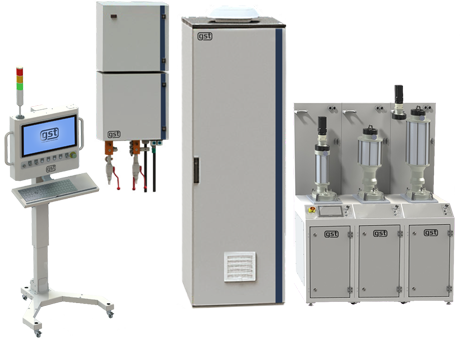
Flame wire spray systems are industrial thermal spraying equipment that use an oxygen-fuel flame to melt continuously fed metal wire and compressed air to atomize the molten tip into droplets. Unlike arc spray, where two electrodes are melted by an electric arc, flame wire spray uses combustion heat and a single feedstock, making the process suitable for protective coating, repair and surface build-up.
GST supplies flame spray equipment for automated production and engineered coating cells. Each system is selected for the feedstock material, substrate geometry, application, required deposition rate and production environment. Typical tasks include corrosion protection, dimensional restoration and functional metal coating of industrial parts.
How flame wire spraying works
In flame spraying, the feedstock is driven into a flame using acetylene or propane with oxygen. The flame supplies the heat required to melt the metal tip while the drive maintains stable material delivery. This melt stage replaces the electrical arc used by twin-wire equipment.
Compressed air atomizes the molten metal into droplets and accelerates each particle in the gas stream toward the prepared surface. The droplets flatten and solidify to form a coating. Stable feed speed, gas flow, air pressure, spray distance and gun movement support consistent spraying.
What a complete system includes
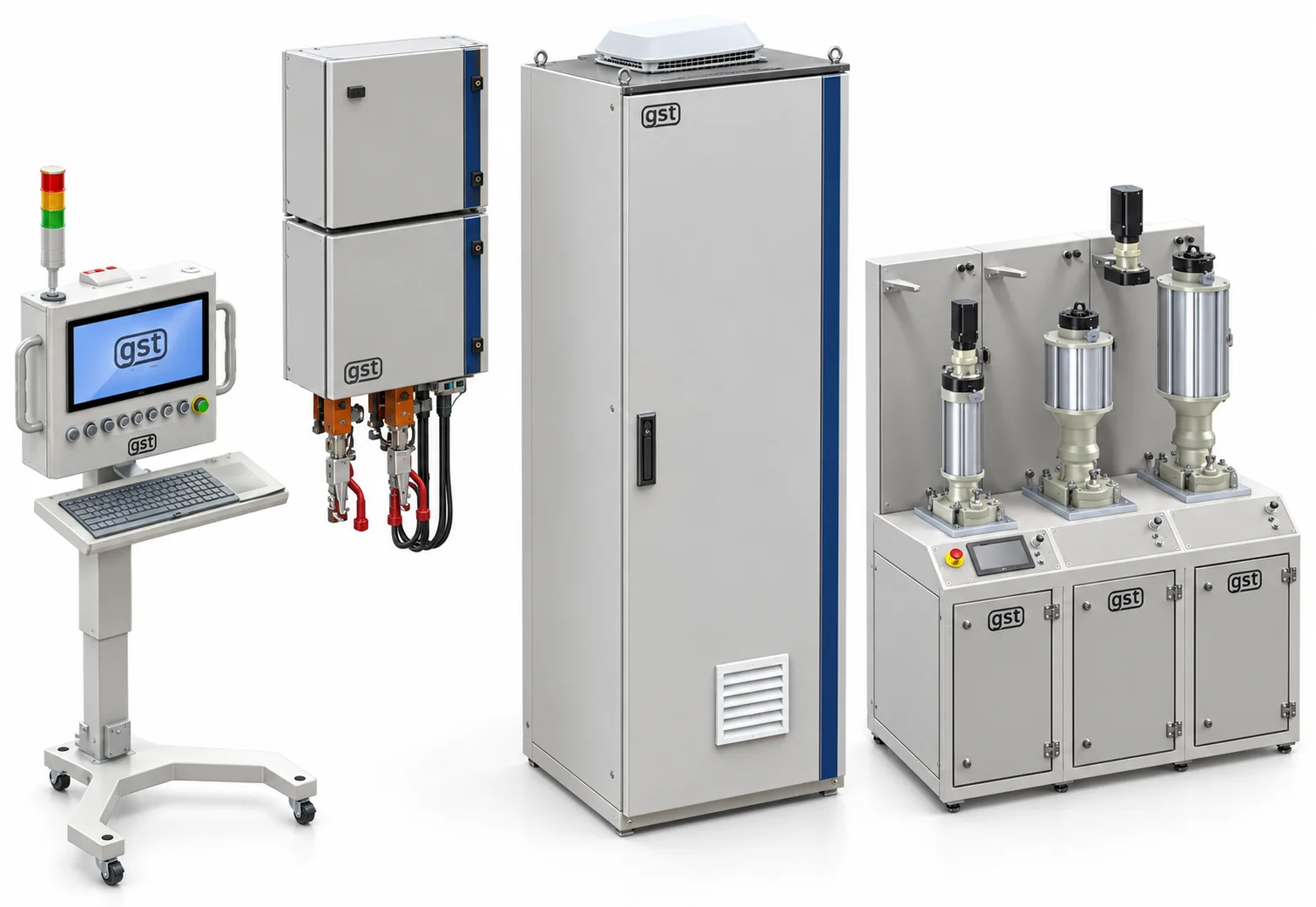
A complete flame spray system includes the flame wire spray gun, wire feed unit, oxygen and fuel-gas controls, compressed-air preparation and process control. These modules coordinate material delivery, flame conditions and atomizing air so the equipment operates as one controlled thermal spraying process.
For automated application, the system can also include a robot or manipulator, workpiece positioner, spray booth, extraction and filtration, acoustic protection and safety interlocks. The coordinated cell maintains repeatable trajectories and a high deposition rate while controlling overspray.
Coating properties
Flame-applied coatings are used where economical metal deposition, corrosion resistance or restoration of worn geometry is required. The technique can build a practical protective coating thickness at a productive deposition rate; final wear resistance depends on material selection, surface preparation and finishing.
Applications and materials
Common materials include zinc, aluminium, zinc-aluminium alloys, bronze, steels and stainless steels. Zinc and aluminium coatings are widely used as corrosion protection coatings on structural steel, infrastructure and marine components. Material choice is matched to the service environment and required surface function.
Other applications include shipbuilding, tanks, pipelines and restoration of shafts, journals and bearing seats. Deposited metal can rebuild worn surfaces before machining or grinding. Compared with powder flame processes, this method is attractive when the coating material is available as wire and high throughput is required.
Delivery and support
GST provides configuration, commissioning and operator training for flame spray projects. Support can include installation, process start-up, spare parts, maintenance guidance and selection of manipulation, filtration and other peripheral equipment.