

Vacuum Plasma Spray (VPS)
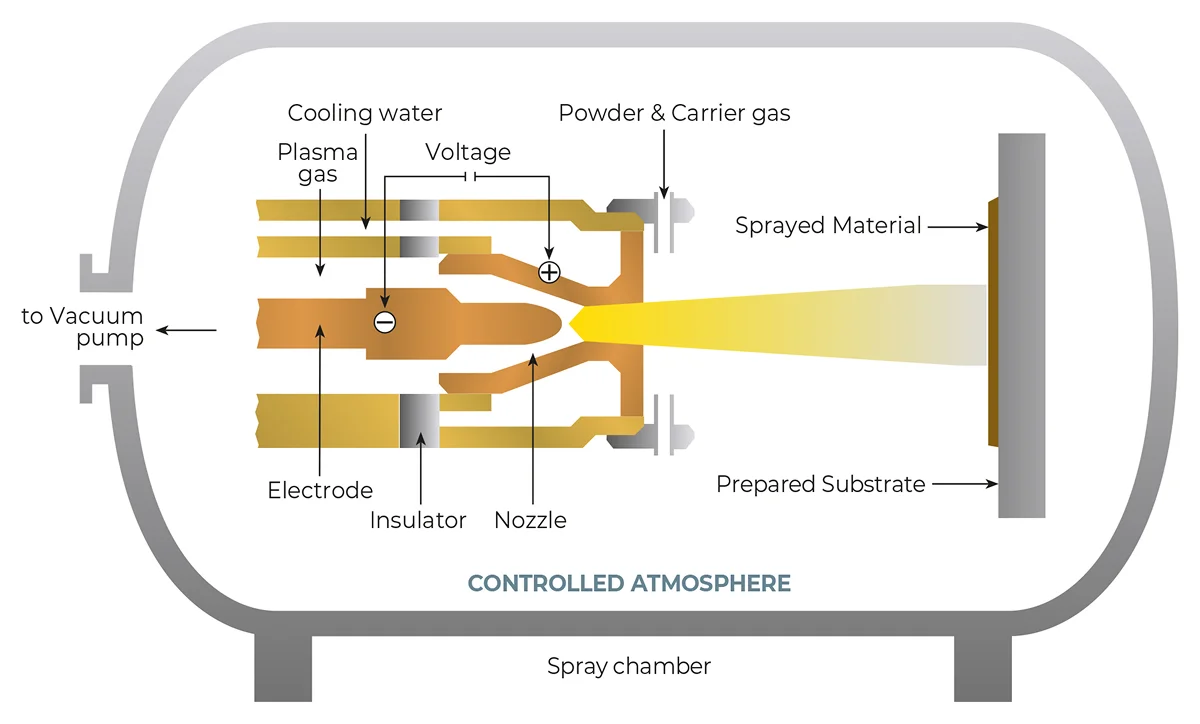
Vacuum plasma spray (VPS), also called low pressure plasma spray (LPPS), is a thermal spray process carried out inside a sealed chamber at reduced pressure. A plasma torch generates a high-energy plasma jet that heats and accelerates powder toward a prepared substrate while the controlled atmosphere limits interaction with ambient air.
Vacuum plasma spraying combines plasma heating with an isolated process environment. It is used when oxidation control, coating chemistry and repeatable structure are especially important, particularly for critical components made from or coated with oxygen-sensitive alloys and other demanding materials.
Why reduced pressure changes the coating
Reduced pressure changes how the plasma jet and heated particles interact with the surrounding atmosphere. With less oxygen around the spray plume, oxidation of the coating material can be reduced, helping the deposited material retain more of its selected chemistry.
The chamber also supports dense coating formation and stable deposition conditions. Controlled pressure and gas composition give the process engineer a defined environment for materials that can be difficult to spray consistently in open air.
VPS compared with atmospheric plasma spray
Compared with atmospheric plasma spray, VPS adds chamber preparation and pressure control but gives greater control over atmosphere exposure. Atmospheric plasma spray is often used for conventional ceramic and general-purpose coating applications.
Vacuum plasma spraying is selected when oxidation sensitivity, alloy chemistry or coating integrity justifies the added complexity. The choice depends on the substrate, material and required coating properties rather than on one process being universally better.
Materials and applications
Typical coating materials include oxidation-sensitive metal alloys, MCrAlY compositions, titanium-based materials and selected ceramic systems. Vacuum plasma spray is well suited to high-temperature and thermal barrier coating architectures.
Applications include aerospace coatings for hot-section components and medical coatings where material condition and surface quality require tight process control. Final coating design depends on the substrate, feedstock material and required service properties.
Systems for vacuum plasma spraying
GST develops plasma spray systems for controlled-atmosphere applications, including the VPS 3000 vacuum plasma spray system. Complete solutions can combine the plasma spray gun, powder feeding, chamber functions, process control and application-specific handling.