

Arc Spraying
Arc spraying is a thermal spray process in which an electric arc forms between two continuously fed metal wires, melting their tips while compressed air atomizes the molten material and propels it toward the prepared surface. The process is also widely known as arc metallizing and is used to build metallic coatings without a combustion flame.
Because the feedstock itself conducts the electrical current, arc spraying converts electrical energy directly into heat at the wire tips. This makes the process well suited to continuous coating operations, especially when high deposition rate, broad surface coverage and economical use of metallic wire are important.
How arc spraying works
In a typical arc spraying process, two electrically conductive wires are driven toward the spray gun at a controlled feed rate. The wires meet at the gun head, where the electric arc is initiated between their ends and rapidly melts the incoming material.
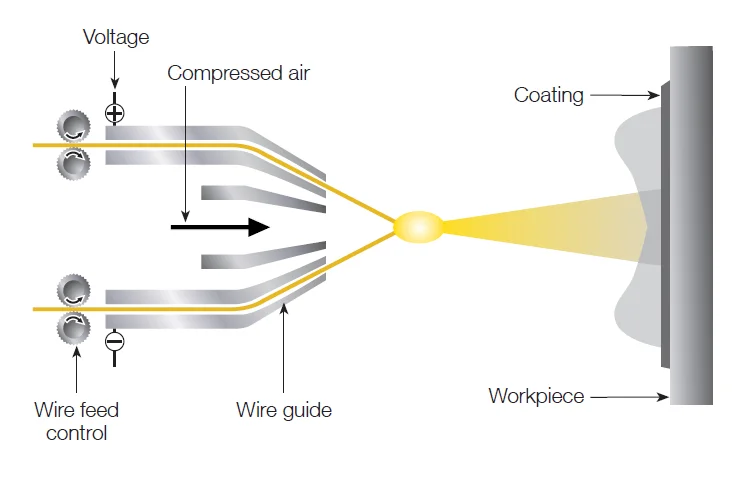
A stream of compressed air passes through the atomizing zone, breaks the molten metal into fine droplets and accelerates them toward the substrate. On impact, the droplets flatten, cool and interlock with previously deposited material, progressively creating the sprayed coating on the component surface.
Twin wire arc spray
Twin wire arc spray is the standard configuration for this technology. Both wires are supplied continuously and must remain synchronized so that the arc is stable and material delivery to the spray zone is consistent throughout production.
Wire transport can be arranged with push or push-pull feeding, depending on the installation and the required working distance between the wire supply and arc spray gun. Push-pull arrangements can support longer routing and more flexible movement where the gun is installed on manipulators, robots or extended hose packages.
Coating properties and deposition rate
A major advantage of arc spray is its deposition capability. Compared with many flame spraying and plasma spraying operations, the process can apply metallic material efficiently over large areas and can build useful coating thickness without repeatedly reheating the entire component.
Coating properties depend on wire chemistry, atomizing conditions, surface preparation and spray parameters. Arc sprayed layers can provide strong mechanical anchoring and practical wear or corrosion resistance, while porosity and surface texture are controlled through process setup and any subsequent finishing operation.
Materials
Common arc spray materials include zinc, aluminium and zinc-aluminium alloys for corrosion protection of steel structures. Stainless steel and bronze wires are used for functional surfaces, repair work and applications requiring specific combinations of corrosion resistance, friction behavior or machinability.
Cored and powder-filled wires extend the range beyond conventional solid wire. They allow alloying elements and hard phases to be introduced into the coating material, giving engineers additional options for wear-resistant surfaces, dimensional restoration and application-specific thermal spray coatings.
Applications
Arc spraying is widely used for corrosion protection of structural steel, including bridges, hydraulic structures, tanks and exposed industrial assets. Large surface areas can be coated with metallic sacrificial layers and, where required, combined with sealers or paint systems as part of a broader protection specification.
The process is also used in shipbuilding and maintenance, and for rebuilding worn engineering components such as shafts, bearing seats and rollers. After spraying, the deposited surface can be machined or finished to restore dimensions and functional geometry when the selected coating system permits it.
Arc spraying compared with other processes
Compared with flame spraying, arc spraying uses an electric arc rather than an oxy-fuel flame to melt the wire. HVOF spraying generally relies on much higher gas-stream velocity, while plasma spraying provides a higher-temperature heat source suited to a wider range of ceramic and high-melting materials.
For projects centered on metallic wire feedstock, high deposition productivity and scalable surface coverage, arc spraying provides a practical thermal spray route. GST supports arc spray applications with arc spray equipment, process integration and arc spray gun solutions selected for the component, wire material and production task.