

HVOF Spraying, Gas Fuel
High velocity oxygen fuel spraying (HVOF) is a thermal spray process in which a fuel is combusted with oxygen to create a fast gas stream that accelerates powder toward a prepared surface. Compared with plasma spraying, HVOF generally operates at a lower process temperature while giving the coating particles a higher impact velocity.
HVOF is widely used where component surfaces must resist wear, erosion or corrosion without changing the bulk material of the part. Gas-fuel HVOF uses gaseous fuels such as propane, propylene or hydrogen, allowing the combustion conditions to be selected for the coating material and the required surface performance.
How HVOF works
Inside the HVOF spray gun, oxygen and fuel are metered into a combustion chamber and ignited to form a high-energy gas flow. The products of combustion expand through the gun nozzle, where the flow is accelerated before leaving the torch as a focused high velocity jet. Stable metering of oxygen, fuel and powder is therefore central to repeatable spraying.
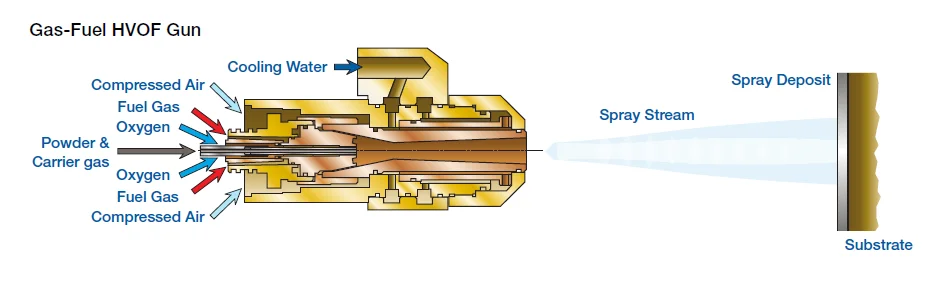
Powder is introduced into this gas stream by a carrier gas and is heated and accelerated toward the substrate. Depending on the material and process settings, particles are softened or partially molten while retaining high momentum. Their velocity at impact is a key factor in producing a compact spray coating with strong interparticle contact.
Gas fuel versus liquid fuel
Gas-fuel HVOF commonly uses propane, propylene or hydrogen, while liquid fuel HVOF typically relies on kerosene. Fuel selection influences flame temperature, gas flow characteristics, particle heating and acceleration, so the preferred process depends on the coating material, component geometry and production objective.
For applications requiring a different heat and momentum balance, GST also supports liquid fuel HVOF and ethanol HVOF technologies. These process families should be selected on the basis of the material system and required coating behavior rather than fuel type alone.
Coating properties
The combination of controlled particle heating and high impact velocity enables HVOF coating processes to produce dense layers with low porosity and strong adhesion to a correctly prepared substrate. The comparatively limited thermal exposure also helps reduce oxidation for many metallic and carbide-based materials.
Particle impact and repeated layer build-up can also create beneficial compressive residual stress in suitable coatings. Together, density, low oxide content and controlled stress state support wear resistance, dimensional restoration and corrosion protection in demanding service conditions.
Materials and applications
Typical HVOF materials include tungsten carbide with cobalt or cobalt-chromium binders, chromium carbide systems, and nickel- or cobalt-based alloys. These coating materials are selected for combinations of hardness, wear resistance, high-temperature performance and protection against aggressive environments.
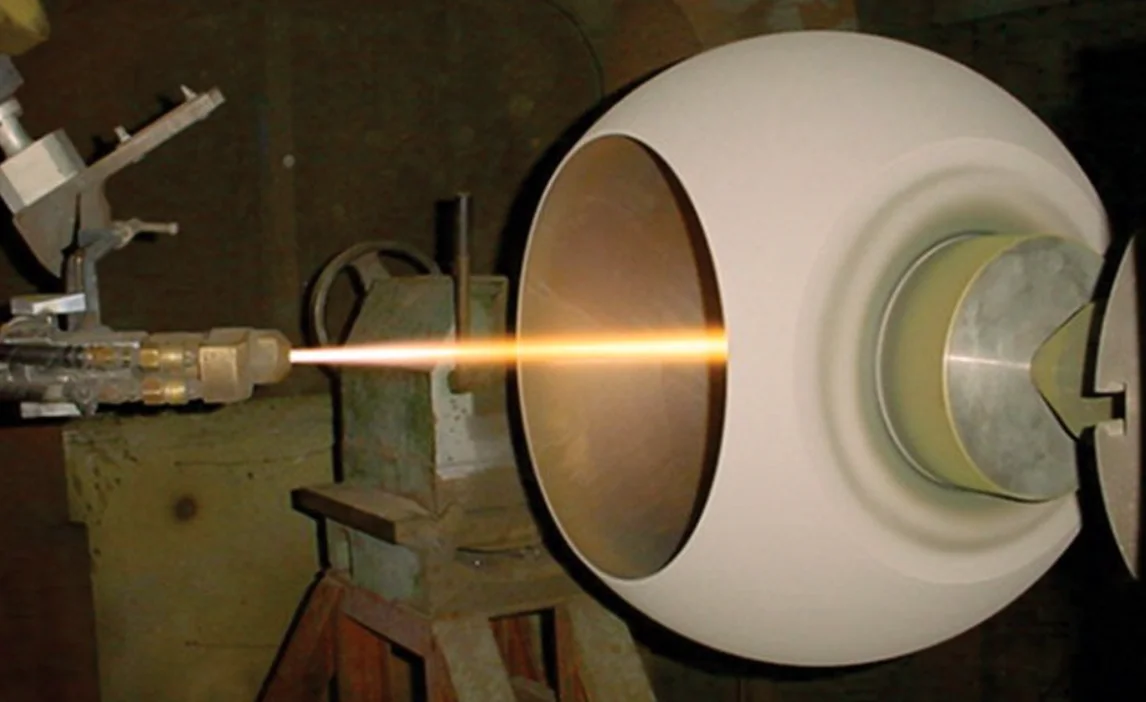
Applications include pump and valve parts, shafts, sleeves, rolls, hydraulic components, turbine and compressor parts, and other surfaces exposed to abrasion, erosion or corrosion. In many industries, HVOF is also considered as an alternative to hard chromium plating where a sprayed coating can meet the functional and dimensional requirements for wear and corrosion protection.
Systems for HVOF spraying
GST supplies HVOF spray systems for gas-fuel processes, integrating process control, powder feeding, gas management and automated handling around the coating task rather than a fixed machine specification.
GST can also provide the appropriate HVOF spray gun and supporting peripherals as part of an integrated thermal spray solution, with commissioning adapted to the customer's component and coating requirements.