

Thermal Spray Coatings for Automotive
Thermal spray is used in the automotive industry to engineer functional surfaces where friction, wear, corrosion and component mass influence performance and service life. Applications range from engine surfaces and piston rings to turbocharger parts, transmission components, suspension hardware and production tooling.
GST supplies thermal spray systems for automotive component manufacturers and vehicle plants that integrate coating processes into workshop cells or production lines. Depending on the application, thermal spray can support lower friction, reduced mass, wear protection, corrosion resistance and controlled restoration of worn or manufactured surfaces.
Cylinder bore coating
Cylinder bore coating is one of the most specialized automotive thermal spray applications. An iron-based plasma sprayed coating can be applied directly to the cylinder bore of an aluminum engine block, replacing a conventional cast iron liner and allowing the functional cylinder surface to be engineered as an integral part of the block.
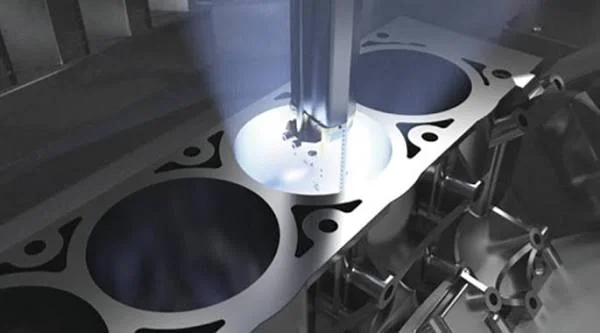
After spraying, the cylinder bore is finished by precision honing to establish the required geometry and surface condition for piston-ring operation. When designed as part of the engine system, this approach can reduce friction and mass and may support lower oil consumption compared with a liner-based architecture. The complete process requires controlled surface preparation, spraying and finishing rather than coating deposition alone.
Piston rings and engine components
Piston rings and selected engine components use wear-resistant coatings to control friction and protect working surfaces. Piston ring coatings may be produced by plasma spraying or by processes such as PVD; GST thermal spray solutions relate specifically to the plasma sprayed route and other thermal spray applications, not to PVD deposition.
Exhaust, turbocharger and thermal barrier coatings
Exhaust components, turbocharger housings and selected high-performance engine parts can use heat-resistant or thermal barrier coating systems to limit thermal loading and protect the underlying material. Process and coating selection depend on the component geometry, substrate and required thermal or wear behavior without relying on a single coating architecture for every application.
Transmission, suspension and chassis parts
Transmission, suspension and chassis components can benefit from thermal spray where shafts, synchronizers, steering parts and other loaded surfaces require improved wear and corrosion resistance. Coatings can be selected for local functional areas while retaining the bulk properties of the base component.
Tooling and repair in automotive production
Automotive production also uses thermal spray for tooling, dies, rolls and other manufacturing assets. Worn or undersized surfaces can be rebuilt to restore dimensions, while selected wear-resistant materials can extend the useful service life of tooling and reduce the need for premature replacement.
Coating processes and GST systems
GST supports atmospheric plasma spraying, HVOF, arc spraying and flame spraying for automotive production tasks. The appropriate process is selected according to coating material, deposition objective, component geometry and finishing requirements, with links to dedicated plasma spray systems, HVOF spray systems and arc spray systems for detailed process configurations.
For serial production, robotic MP3000 platforms can integrate controlled motion, repeatable spray parameters and process-data recording into an automated coating cell. GST can combine spray technology, material feed, control, handling and application-specific integration around the production requirement; plasma spray guns are selected separately according to the validated coating task and geometry.