

HVOF Spraying, Liquid Fuel
Liquid fuel HVOF is a high velocity oxygen fuel spraying variant that uses a liquid hydrocarbon, typically kerosene, instead of a gaseous fuel. It belongs to the same HVOF spraying family but changes how energy is released and transferred through the combustion section.
For applications where gas fuel HVOF is not the preferred route, liquid fuel operation provides an alternative process window for accelerating powder while keeping thermal exposure comparatively controlled. The choice is driven by coating material, production scale and the required coating response.
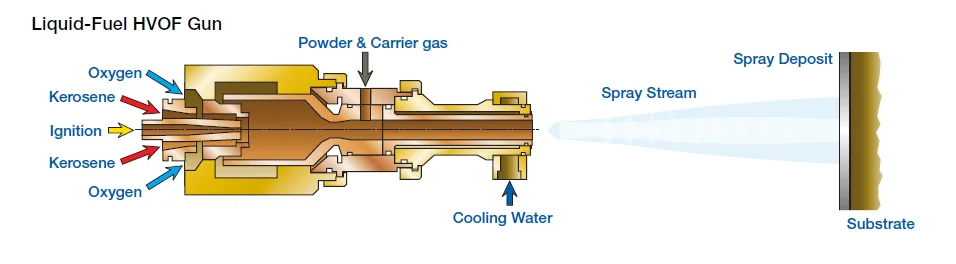
Kerosene as fuel
Kerosene is metered with oxygen and burned in the combustion chamber, creating a high-energy gas flow that is expanded through the nozzle. The chamber and fuel system are configured around liquid-fuel combustion, influencing heat release and the way the flow develops before powder is accelerated toward the part.
What liquid fuel changes in the coating
In liquid fuel HVOF, particle velocity can be increased while particle temperature remains comparatively lower than in hotter thermal spray processes. This balance is particularly useful where kinetic energy at impact is important for compact coating formation.
The resulting HVOF coating can combine dense structure, low porosity and limited oxide formation when the process is matched correctly to the powder and substrate. Tungsten carbide and other carbide-based materials are common choices where wear resistance is a primary requirement.
When to choose liquid fuel
Liquid fuel HVOF is often selected for substantial carbide coating programs, larger production batches and applications where fuel consumption and operating economics matter alongside coating performance. It is also relevant to components requiring durable wear protection.
GST can integrate liquid fuel HVOF into dedicated spray systems, including the MP 3000 HVOF-LF, with configuration selected for the coating material and component.