

Aerospace Thermal Spray
Aerospace thermal spray protects and restores aircraft components exposed to heat, wear, particle erosion and corrosion. Depending on the application, a spray coating can provide thermal protection, improve wear resistance or rebuild a worn surface for continued service in production and overhaul.
GST supplies thermal spray systems for aerospace manufacturers and maintenance facilities applying these coatings in-house. The process route is selected around the component, coating material and required function, from turbine hot-section protection to landing gear repair and dimensional restoration.
Thermal spray coatings for aircraft engines
Aircraft engines use different coating architectures because temperatures, loads and erosion mechanisms vary by section. In the hot section, a thermal barrier coating commonly combines a ceramic top layer with an MCrAlY bond coat, creating a layered system that helps protect the underlying alloy from high-temperature exposure and oxidation during engine operation.
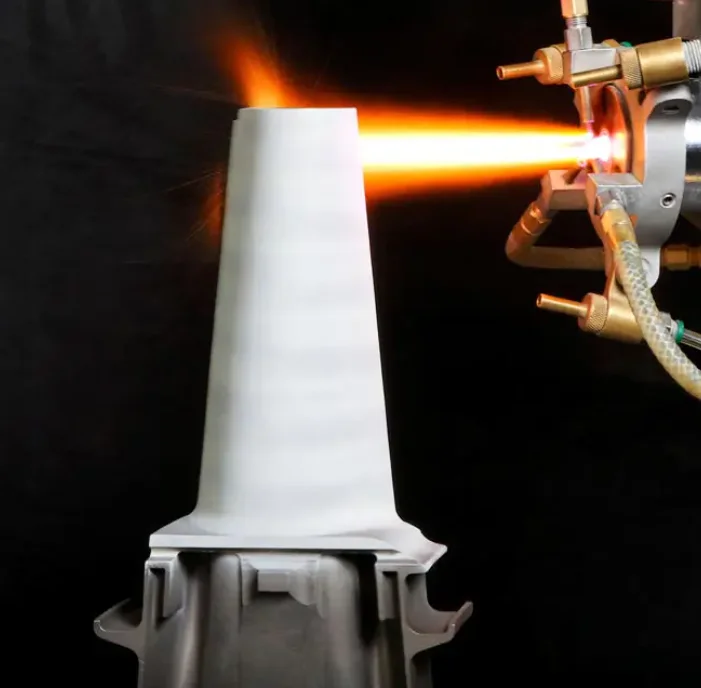
Compressor components require a different balance of properties. Thermal spray coatings can be applied to compressor blades and related parts to improve wear and particle-erosion resistance while preserving the surface condition required for reliable engine operation. Related turbine blade coatings are also used in power-generation gas turbines.
Abradable coatings for clearance control
Abradable coating systems are applied to selected compressor and turbine sealing areas to control running clearance. During operation, the rotating blade tip can cut into the softer abradable layer rather than requiring a permanently large gap between rotating and stationary components.
Reducing this clearance helps limit gas leakage and supports engine efficiency while protecting the blade from damaging contact with a hard casing surface. Depending on the coating material and location, abradable layers can be deposited by plasma spray or powder flame spray processes.
Landing gear and hard chrome replacement
Landing gear rods, axles and other highly loaded steel components can use HVOF tungsten carbide coatings as an alternative to hard chrome in suitable applications. These coatings are selected where high wear resistance and durable surface protection are required during repeated service cycles.
Surface preparation is part of the complete coating route. Shot peening may be used where compressive surface treatment is specified, followed by controlled grit blasting before spraying to create the surface condition required for coating application. Masking protects areas that must remain uncoated.
Repair and restoration of aerospace components
Thermal spray is also used during aerospace maintenance to restore worn dimensions on shafts, bearing seats and other repairable parts. The repair sequence can include removal of the previous coating, inspection and surface preparation, deposition of a replacement layer, and final machining to the required component geometry. This allows coating restoration to be incorporated into an established overhaul route.
Coating processes and GST systems
Aerospace coating production can combine atmospheric plasma spray, vacuum plasma spraying and HVOF. APS is widely used for ceramic and other plasma-sprayed layers, while VPS provides a controlled low-pressure atmosphere for oxidation-sensitive materials such as selected MCrAlY bond coats and other alloy layers where atmospheric interaction must be limited.
For wear and corrosion protection, GST HVOF spray systems can be configured for gas-fuel or liquid-fuel operation. Robotic MP 3000 platforms and the VPS 3000 system support repeatable programmed motion, controlled process sequences and recording of relevant operating parameters, helping production teams maintain defined recipes and process traceability.
Surface preparation and coating quality
Coating quality begins before spraying. Grit blasting, cleaning, masking and controlled handling establish the prepared substrate, while production checks verify coating thickness, adhesion and other specified properties. GST integrates spraying with preparation, automation and process-control functions so the complete route can be adapted to the customer's manufacturing or repair workflow and final acceptance route.