

There are currently no active products
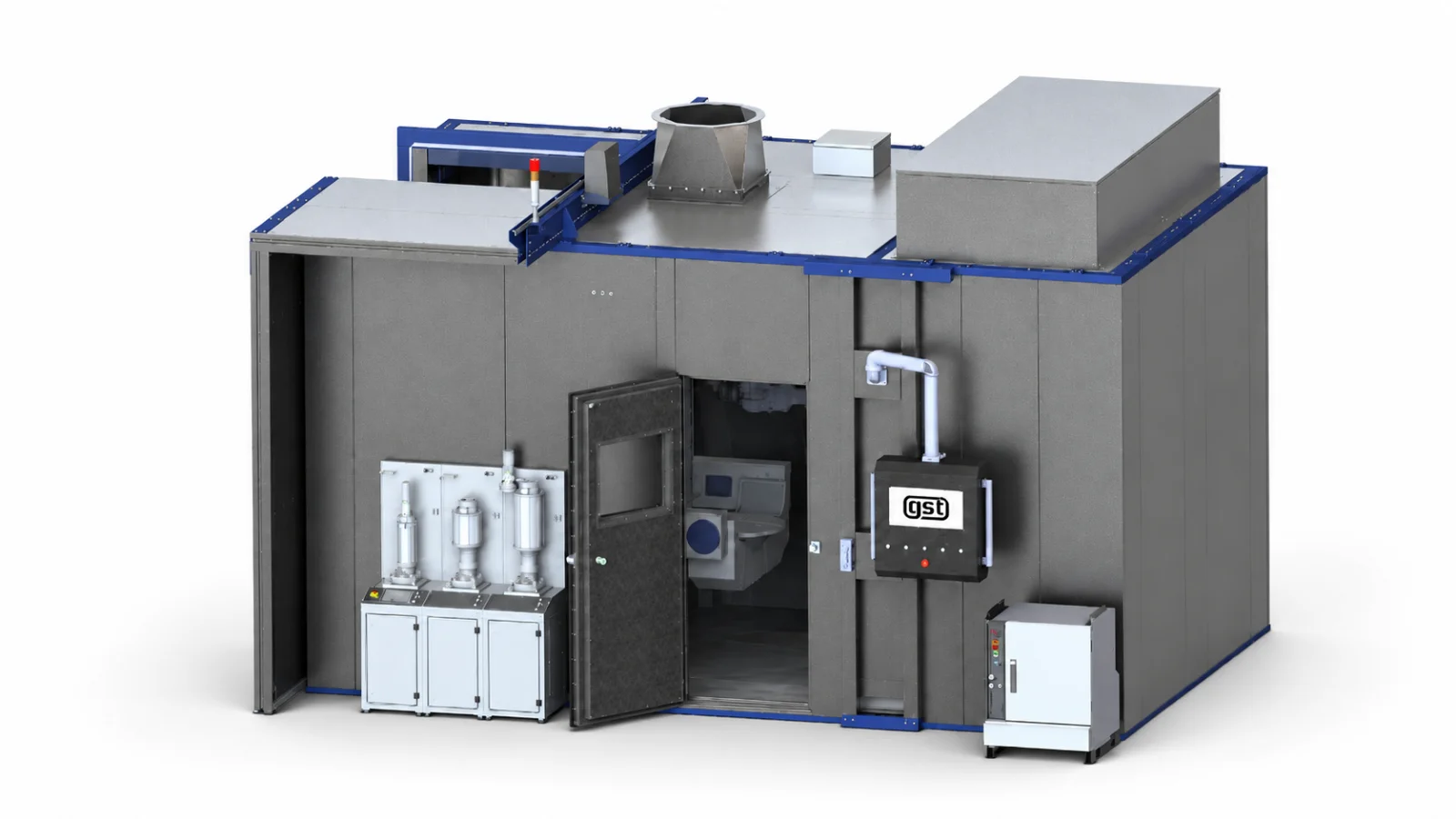
The GST Soundproof Thermal Spray Booth is a modular acoustic enclosure engineered for industrial thermal spray cells where noise, overspray, heat and airborne process emissions must be controlled within a defined production area. The booth can be configured for atmospheric plasma spraying (APS), HVOF, flame spraying and electric arc spraying, and is suitable for both stand-alone coating stations and fully automated robotic systems.
The enclosure is assembled from multi-layer acoustic panels. A stainless-steel outer skin provides a durable industrial surface, while the internal perforated steel lining and sound-absorbing layers help attenuate process noise generated by plasma jets, HVOF combustion and other high-energy spray processes. The panel package can combine absorptive, reflective and vibration-damping materials according to the required acoustic performance.
Each booth is engineered around the customer’s process, workpiece dimensions, loading method and ventilation requirements. Door arrangements can include single- or double-leaf hinged doors, sliding doors, or an L-shaped manual or motorized loading door for handling large components with an overhead crane. Sealed service penetrations can be provided for electrical cables, process hoses, robot utilities, compressed air and extraction ductwork.
The booth is designed for integration with a dedicated exhaust and filtration system. Controlled make-up air, inlet silencers and an extraction hood positioned in the spray zone help maintain directional airflow and remove hot, dust-laden air from the working area. When correctly engineered as part of the complete coating cell, the enclosure supports safer operation, improved process stability and a cleaner production environment.
Key benefits
- Acoustic protection for high-noise thermal spray processes, with project configurations engineered for operating noise levels down to approximately 75 dB under defined site and process conditions.
- Operator protection from high-velocity particles, sparks, overspray and thermal radiation generated during coating operations.
- Modular panel construction allows the booth dimensions, internal layout and external finish to be adapted to the customer’s production area and workpiece envelope.
- Multi-layer acoustic panel system with stainless-steel exterior, perforated steel interior and sound-absorbing filling for industrial durability and effective noise attenuation.
- Designed for direct integration with industrial exhaust and filtration equipment to capture dust and hot process air at source.
- Flexible access options including hinged, sliding and L-shaped doors for manual, forklift or overhead-crane workpiece loading.
- Sealed utility penetrations simplify integration of robots, positioners, spray guns, hoses, electrical wiring and process monitoring equipment.
- Isolation of the spray zone from drafts and external temperature fluctuations helps maintain more stable and repeatable coating conditions.
- Suitable for integration with GST MP3000 plasma, HVOF and flame spray systems as part of a complete automated thermal spray cell.
Technical Specifications
| Parameter | Specification |
|---|---|
| Equipment type | Modular soundproof / acoustic enclosure for thermal spray systems |
| Compatible spraying processes | Atmospheric plasma spraying (APS), HVOF spraying, flame spraying, electric arc spraying |
| Panel construction | Multi-layer modular acoustic panels |
| Outer panel surface | Stainless-steel sheet |
| Inner panel lining | Perforated steel sheet |
| Acoustic filling | Sound-absorbing materials of different densities; project-specific combination of absorptive, reflective and vibration-damping layers |
| Acoustic performance | Engineered for process-noise reduction; operating noise level down to approximately 75 dB under defined project conditions |
| Air inlet | Sized make-up-air inlet / plenum with acoustic silencer |
| Ventilation interface | Prepared openings for extraction ductwork; extraction hood positioned in the spray zone; integration with GST filtration units available |
| Air prefiltration | Coarse-particle prefiltration, including G4-class prefiltering where specified |
| Workpiece access | Single- or double-leaf hinged door, sliding door, or L-shaped manual / motorized loading door |
| Door safety | Acoustic seals; electromechanical interlocks and emergency release available depending on configuration |
| Viewing windows | Multi-layer tempered safety glass with UV protection and anti-fog treatment available |
| Lighting | Integrated industrial LED lighting; IP67 fixtures and HMI brightness control available |
| Utility penetrations | Sealed entries for electrical cables, hoses, process media and auxiliary equipment |
| Booth dimensions | Project-specific according to workpiece, robot envelope, loading method and production layout |
| Colour / external finish | According to customer requirements |
Construction and Acoustic Design
The booth uses a modular panel architecture so that the enclosure can be sized around the spraying equipment, robot working envelope, workpiece positioner and service zones. The acoustic wall package combines a rigid outer stainless-steel surface with an internal perforated steel lining and sound-absorbing media. Depending on the required performance, the panel system can also incorporate reflective and vibration-damping layers to reduce transmission of both airborne and structure-borne noise.
The final acoustic result depends on the spray process, source noise level, booth geometry, door and service openings, ventilation airflow, building acoustics and the measurement method. For this reason, GST defines the required acoustic performance during engineering of the complete project rather than treating the booth as a universal catalogue-size enclosure.
Access, Loading and Service Openings
The access system is selected according to component size and material flow. Compact cells can use single- or double-leaf hinged doors, while larger installations may use sliding or L-shaped doors. An L-shaped motorized or manually operated door is particularly useful when heavy workpieces must be loaded from above by an overhead crane. Door seals are selected to preserve acoustic isolation and to limit uncontrolled air leakage.
Optional loading hatches, sealed cable penetrations and dedicated service passages can be incorporated into the enclosure. These interfaces allow the spray gun, robot, workpiece positioner, cooling circuits, process gases, powder hoses, instrumentation and electrical systems to be connected without compromising the functional separation of the spray area.
Ventilation and Filtration Integration
Thermal spraying generates dust, overspray and significant heat. The GST booth is therefore designed as part of a controlled airflow system rather than as an isolated acoustic room. Make-up air enters through a sized inlet section with an acoustic silencer, while contaminated air is extracted from the spraying zone through a dedicated hood and duct connection.
The enclosure can be integrated with GST industrial exhaust and filtration units so that airborne particles are captured and filtered before clean air is discharged or handled according to the project ventilation concept. Coarse-particle prefiltration at the air inlet can also be incorporated where required. Airflow, filtration capacity and duct geometry are selected for the specific spray process and booth volume.
Lighting and Operator Safety
Integrated industrial LED lighting provides visibility for setup, maintenance and inspection inside the booth. Depending on the project, IP67-rated luminaires with brightness adjustment through the HMI can be supplied. Multi-layer tempered viewing windows with UV protection and anti-fog treatment can be included where visual monitoring of the process is required.
Door interlocks, electromechanical locks and emergency release devices can be incorporated into the cell safety architecture. The booth also provides a physical barrier between personnel and the spray process, helping protect operators from high-velocity particles, sparks and thermal radiation. Final safety functions are coordinated with the complete machine risk assessment and control-system design.
Integration with GST Thermal Spray Systems
The soundproof booth can be engineered as a peripheral module for GST MP3000 atmospheric plasma, HVOF and flame spray systems. In automated installations, the booth can accommodate an industrial robot or manipulator, one or more workpiece positioners, powder feeders, process monitoring equipment, cooling systems and a dedicated exhaust filter unit.
GST can engineer the complete cell around the coating process so that access, robot reach, spray distance, workpiece handling, airflow, acoustic protection, filtration and operator safety are considered as one coordinated production system.
Optional Configuration
- Single- or double-leaf acoustic hinged doors.
- Sliding acoustic doors for side loading.
- L-shaped manual or motorized doors for overhead-crane loading.
- Electromechanical door locks, safety interlocks and emergency release.
- Multi-layer tempered viewing windows with UV protection and anti-fog treatment.
- IP67 industrial LED lighting with optional HMI brightness control.
- Workpiece loading hatches and custom service openings.
- Sealed cable, hose and utility penetrations.
- Air inlet plenum with silencer and optional coarse prefiltration.
- GST exhaust and filtration system matched to the booth and spray process.
- Integration with robots, manipulators, positioners and GST MP3000 process equipment.
Applications
GST soundproof thermal spray booths are intended for coating cells where high process noise, overspray, heat and dust must be contained while maintaining controlled access and ventilation. The final booth configuration is engineered around the customer’s coating technology, production rate, workpiece geometry and plant layout.
- Atmospheric plasma spray cells for ceramic, metallic and functional coatings.
- Gas-fuel and liquid-fuel HVOF production cells.
- Flame spray installations for powder or wire processes.
- Electric arc spray cells.
- Robotic thermal spray lines requiring controlled acoustic and ventilation conditions.
- Manual or mechanized coating stations where operator exposure to process noise and overspray must be reduced.
- New thermal spray installations and modernization of existing coating areas.
FAQ
What thermal spray processes can the GST Soundproof Thermal Spray Booth be used for?
The booth can be configured for atmospheric plasma spraying, HVOF spraying, flame spraying and electric arc spraying. The ventilation and acoustic design is selected for the specific process and equipment configuration.
What noise level can the booth achieve?
Project configurations can be engineered for an operating noise level down to approximately 75 dB under defined conditions. The actual result depends on the source noise level, booth dimensions, openings, ventilation system, building acoustics and measurement method.
How are the acoustic panels constructed?
The modular panels use a stainless-steel outer surface, a perforated steel inner lining and sound-absorbing materials of different densities. Additional reflective or vibration-damping layers can be incorporated according to the required acoustic performance.
Can the booth be connected to a dust extraction and filtration system?
Yes. The enclosure is designed for controlled make-up air and local extraction from the spray zone and can be integrated with GST exhaust and filtration equipment sized for the selected thermal spray process.
Can large workpieces be loaded by overhead crane?
Yes. An L-shaped manual or motorized door can be supplied to provide top and side access for loading large components with an overhead crane.
Are the booth dimensions standard?
No. The dimensions and layout are project-specific and are selected according to the workpiece envelope, robot reach, positioner, service zones, loading route and available production area.
Can the booth be integrated with a robotic thermal spray system?
Yes. The booth can be engineered around industrial robots or manipulators, workpiece positioners, GST MP3000 process equipment, cooling systems, monitoring equipment and the required safety interlocks.
What access and safety options are available?
Depending on the project, the booth can include hinged or sliding doors, electromechanical locks, safety interlocks, emergency release, viewing windows, loading hatches and sealed cable or hose penetrations.
Can GST design a booth for an existing thermal spray installation?
Yes. A custom enclosure can be engineered for an existing coating area after review of the process, equipment arrangement, noise source, extraction requirements, workpiece handling method and available installation space.
What information is required to prepare a quotation?
GST typically requires the spray process, spray gun or system model, workpiece dimensions and mass, robot or manipulator data, loading method, required booth dimensions or available floor space, target noise level, ventilation conditions and any site-specific safety requirements.