

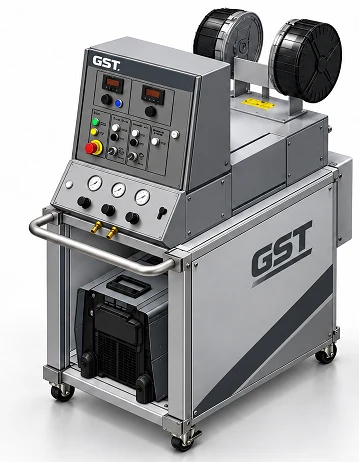
Arc spray systems are industrial thermal spray equipment for depositing metal coatings from two continuously supplied wires. The process is also known as metallizing and is used where high deposition productivity, corrosion protection or dimensional restoration is required. Unlike flame wire spray, the feedstock is melted by an electric arc rather than by a fuel-gas flame.
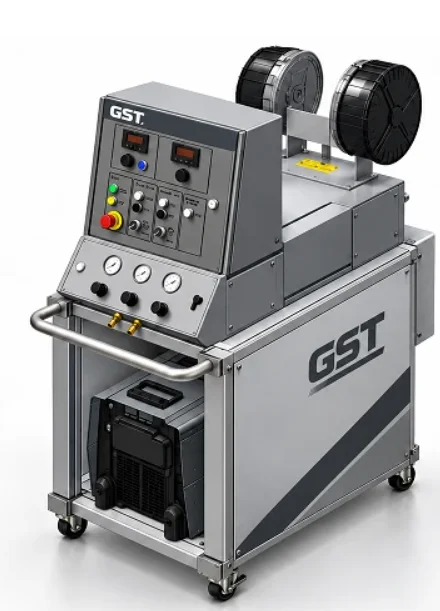
GST supplies arc spray equipment for protective and engineering coating applications. The installation is configured around the selected material, component geometry, production rate and automation level, with the MP 3000 ARC System serving as the category platform for integrated industrial coating lines.
How Arc Spraying Works
Two electrically conductive electrodes are advanced toward one another through the spray gun. When their tips reach the correct gap, an electric arc forms and melts the feedstock material. Stable electrical power and electrode delivery are essential for maintaining a repeatable process.
Compressed air passes through the spray head and atomizes the molten metal into fine droplets, carrying them toward the prepared substrate. On impact, the particles flatten and build the arc spray coating. Compared with flame wire spraying, twin wire arc technology can provide a higher deposition rate because both consumable electrodes are melted continuously by electrical energy.
Push and Push-Pull Wire Feed
In a push arrangement, the drive unit advances both consumables through the hose package toward the spray head. This layout suits controlled routing and moderate working distances, while correct liners and drive settings help maintain stable material delivery.
For longer hose packages, softer wire or installations requiring additional delivery stability, a push-pull arrangement adds a second driven stage close to the applicator. The two drives work together to reduce slip and improve continuous transport. Permitted hose length depends on material, diameter, drive design and the final GST configuration.
What a Complete System Includes
A complete arc spray system typically combines the power source, applicator, wire feed unit, compressed-air preparation and process controls. The equipment is selected as one coordinated package so that current, voltage, consumable delivery and atomizing air can be adjusted for the required application.
Industrial arc spraying can also be integrated with a robot or manipulator, workpiece positioner, spray booth, acoustic enclosure and exhaust filtration. These peripheral modules support controlled motion, safe handling of overspray and fumes, and repeatable production when the MP 3000 ARC System is incorporated into an automated coating cell.
Coating Properties
The technique is valued for its high deposition rate and its ability to build protective or engineering coating layers on large surfaces and components. Final thickness, adhesion, porosity and surface condition depend on the selected material, substrate preparation, operating parameters, motion and qualification procedure.
Because the process uses continuous metal feedstock rather than powder, material handling is straightforward and long spray runs are practical for large-area work. The resulting layer can be selected for corrosion resistance, wear resistance or dimensional restoration according to the alloy and service conditions of the part.
Anti-Corrosion Applications
Zinc, aluminum and zinc-aluminum materials are widely used for anti-corrosion protection of steel structures. Typical applications include bridges, hydraulic structures, tanks, marine and shipbuilding components, and other steel surfaces exposed to atmospheric or industrial corrosion.
Wire arc spray is also used for engineering restoration. Suitable alloys can rebuild worn shaft journals, roll surfaces, bearing seats and other parts before final machining or grinding. This makes the technique useful where dimensional restoration is required together with surface protection.
Delivery and Support
GST can supply the MP 3000 ARC System as process equipment or as part of an integrated coating installation. Project scope can include system configuration, peripheral equipment selection, integration with manipulators or robots, commissioning and operator training.
Service support can include start-up assistance, maintenance guidance, spare parts supply and retrofit work for new or existing thermal spray lines. The final installation is configured around the customer’s coating material, component geometry, production requirements and site conditions.